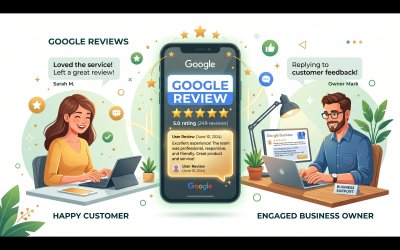

Why Reviews Are the Single Most Powerful Factor in Local Search
Here is a number that should change the way you think about every customer interaction your business has: 93% of consumers say online reviews influenced their purchase decision. Not some consumers. Not most consumers. 93% of them. And 84% of those people trust online reviews as much as a personal recommendation from someone they know and trust.
In local search specifically, reviews are one of the top three ranking factors that Google uses to determine where your business appears in the Map Pack. They are not a nice-to-have or a vanity metric -- they are a core component of the algorithm that determines whether you are visible to the customers who are actively looking for exactly what you offer right now.
In 2026, the sophistication with which Google uses reviews has increased dramatically. It is not just about how many you have or what your average star rating is. Google's AI now analyses the sentiment expressed in each review, detects which specific services are mentioned by name, evaluates the authenticity and history of each reviewer's account, measures how quickly and professionally you respond, and uses all of this data collectively to build a detailed picture of your business's quality, reliability, and relevance for specific service types.
The bottom line is stark: a business with 200 reviews averaging 4.6 stars, with active, personalised responses to every review, will consistently outrank a business with 15 reviews averaging 5.0 stars and no responses. Volume matters. Recency matters. Keyword richness in the review content matters. Your response rate matters. Every single dimension compounds together into your overall review prominence score.
If your GBP profile is not set up to support an effective review strategy, that is the first thing to fix. Run our free GBP audit tool to see your complete profile score and identify exactly what needs addressing before you start driving new reviews.
Understanding What Google Actually Looks for in Your Review Profile
Recency: The Freshness Signal
A review from last week carries significantly more weight in Google's algorithm than one from two years ago. This is because a recent review signals two things simultaneously: first, that your business is still actively operating and serving customers, and second, that customers are still having good enough experiences to be motivated to leave reviews. A business with 500 reviews all from 2021 is actually more vulnerable in local rankings than one with 80 reviews spread evenly over the past 12 months.
The implication is clear: review generation cannot be a burst activity. It needs to be a consistent, ongoing process that is built into your regular business operations. Even just 2-4 new reviews per month, sustained over 12 months, creates a dramatically more compelling recency profile than 30 reviews in a single month and then silence.
Keyword Relevance: The Service Signal
When a customer writes "Sarah came out the same day and fixed our emergency boiler breakdown -- incredibly professional and explained everything clearly" -- that review is not just expressing satisfaction. It is telling Google that your business performs emergency boiler repairs, that you offer same-day service, that your team is professional, and that you communicate well with customers. All of those are matching signals for specific search queries.
Compare that to a review that just says "Great service, highly recommend!" -- which is positive but provides Google with almost no usable information about what specific services you deliver or how well you deliver them. You want both types, but you want as many of the keyword-rich, specific variety as possible. You cannot ask customers to include specific phrases -- that would be manipulation -- but you can ask them to describe their specific experience, which naturally produces more detailed and useful review content.
Response Rate and Quality: The Engagement Signal
Google explicitly states that responding to reviews demonstrates that you value your customers and that your business is actively managed. In 2026, businesses with a 100% review response rate consistently outperform those with partial or no response rates in local rankings, all else being equal. It is also one of the most visible trust signals for potential customers reading your profile -- seeing that you respond thoughtfully to every single review, positive or negative, tells them a great deal about what it would be like to be your customer.
Volume and Growth Rate: The Popularity Signal
Pure review volume signals to Google that your business has served a large number of customers successfully. Growth rate -- how quickly your review count is increasing -- signals current business health and activity. A business that had 50 reviews six months ago and now has 90 is showing strong growth signals. A business with 500 reviews accumulated over five years and no new ones in the past three months is showing stagnation signals.
Building a Systematic Review Generation Strategy
The businesses that consistently top local search rankings in their category did not get there by hoping satisfied customers would spontaneously leave reviews. They built systems -- repeatable, consistent processes that make review generation a predictable, scalable part of their business operations rather than a sporadic hope.
The 48-Hour Window
The optimal time to request a review is within 24-48 hours of service completion. At this moment, the customer's experience is fresh, they are most likely still feeling good about the result, and they have not yet fully moved on to the next thing on their to-do list. The response rate to review requests sent within 48 hours is typically 3-5 times higher than those sent a week or more later. The message should be brief, genuine, and include a direct link to your review page -- not a link to your website and instructions for finding the review button. Every additional step reduces response rate.
SMS: Your Highest-Response Channel
Text messages have a 98% open rate. Email open rates average around 20-25% for business communications. For review requests, SMS is dramatically more effective than email for most local businesses, particularly those in trade services, healthcare, and hospitality. The message should feel personal, not automated. Using the customer's name, referencing the specific work done or visit, and coming from a recognisable number all significantly increase response rates.
An example that works well: "Hi [Name], it was great to see you today. If you are happy with your [specific service], we would really appreciate a quick Google review -- it makes an enormous difference to a small business like ours. Here is the link: [direct review URL]. Thank you so much, [Your Name]."
Notice the personalisation, the specific service reference, the genuine human tone, and the direct link. No corporate language. No lengthy explanation. Just a genuine ask from a real person with a direct path to action.
Email Follow-Up Sequences
For businesses that collect customer email addresses through bookings, purchases, or account creation, a two-email follow-up sequence typically outperforms a single request. Send the first review request 24-48 hours after service. If no review is left within 5-7 days, send a gentle, brief follow-up: "Hi [Name], I sent you a note a few days ago about leaving us a review. No worries at all if you have been busy -- but if you do have two minutes, your feedback really does help us. [link]." The second email typically captures 30-40% of the responses that the first email alone would have missed.
QR Codes: Removing All Friction
The biggest barrier to review generation is not customer unwillingness -- it is friction. If a customer has to open Google, search for your business, find the review button, and then write their review, many will intend to do it and never get around to it. A QR code that opens directly to your review submission page removes all of that friction. Place QR codes on your receipts, invoices, business cards, at your physical location (counter top, beside the door, on tables), and on any printed materials your customers receive.
For service businesses that complete work at customer premises -- plumbers, electricians, cleaners, landscapers -- having a laminated card with a QR code that you hand over at job completion is an extremely effective low-friction review request. The customer scans it while you are still there, their experience is fresh, and the direct link means they can complete it in under two minutes.
The In-Person Ask
Despite the availability of automated digital review request systems, a genuine, face-to-face ask at the point of service remains one of the most effective review generation tactics available. Train every member of your customer-facing team to make the ask naturally and authentically as part of closing a transaction or completing a service: "If you are happy with everything today, we would really love it if you could leave us a quick Google review -- it genuinely helps us out. I can send you the link if that would be easier." Authenticity and specificity -- knowing the customer's name, referencing what they purchased or had done -- dramatically improve response rates over a generic scripted request.
Your Email Signature and Digital Touchpoints
Every email your business sends is a touchpoint with a customer or prospective customer. Adding a simple "Happy with our service? Leave us a Google review" line with a direct link to your email signature costs nothing and produces a steady trickle of review requests from your regular communications. Similarly, adding a review request to your post-purchase or post-service emails, to your website's thank-you pages, and to your social media bios creates ambient review generation that requires no ongoing effort once set up.
What You Must Never Do When Generating Reviews
Google's review spam detection in 2026 is powered by sophisticated AI that analyses reviewer behaviour patterns, account history, device fingerprints, IP addresses, and the timing and clustering of reviews. The following tactics will either get caught quickly or have already been made effectively unworkable:
Never offer incentives for reviews. Any form of compensation -- discounts, free products, cash, gifts, loyalty points -- in exchange for a review violates Google's guidelines. This applies even if you say "for any review, positive or negative." The exchange of value for a review is the violation, regardless of whether you ask for a positive rating.
Never create fake reviews. Reviews from employees, friends, family, or anyone who has not genuinely used your service are fraudulent. They violate Google's policies and can be detected through account history analysis and reviewer behaviour patterns. Even if they are not detected immediately, they create legal liability for your business in many jurisdictions.
Never practise review gating. Sending a satisfaction survey first and only passing satisfied customers through to the review page, while filtering negative responses away, is explicitly prohibited by Google's review policies. All customers should receive the same review invitation regardless of their prior indicated satisfaction level.
Never request reviews in sudden bulk quantities. If your business has had 20 reviews over three years and suddenly receives 50 in one week, Google's spam systems will flag this as suspicious and may remove many or all of those reviews. Build your review profile steadily and consistently, not in sudden spikes.
How to Write Outstanding Responses to Positive Reviews
Most businesses either ignore positive reviews or respond with the same generic template every time ("Thank you for your kind words! We look forward to seeing you again!"). Both approaches are missed opportunities. Positive review responses should feel genuine, personal, and substantive. They are publicly visible and function as micro-advertisements for your business to every future customer who reads them.
Use the reviewer's name if they provided it. Reference the specific service, purchase, or experience they mentioned. Express genuine appreciation rather than corporate-speak. Include a specific keyword relevant to the service they mentioned -- this adds a natural keyword signal without feeling forced. And if appropriate, mention something that invites continued engagement with your business.
Example of a strong positive review response: "Thank you so much, Michael -- we are really glad the emergency call-out worked out so smoothly for you. A burst pipe at 9pm on a Sunday is no fun, so we were glad to get there quickly and get it sorted without any damage to your floors. Whenever you need any plumbing work in the future, please do not hesitate to reach out. Really appreciate you taking the time to leave this review -- it means a lot to the whole team."
That response is personal, references the specific emergency situation, includes relevant keywords (emergency call-out, burst pipe, plumbing work), expresses genuine appreciation, and invites future business. Compare that to "Thanks for the great review!" and the difference in quality -- and in the impression it creates on prospective customers -- is enormous.
How to Handle Negative Reviews Without Damaging Your Reputation
Every business with any volume of customers will eventually receive a negative review. How you handle it is often more impactful on your reputation than the negative review itself. Potential customers who read your negative reviews are simultaneously evaluating how you respond -- they are deciding what it would be like to be your customer if something went wrong.
A business that responds to negative reviews calmly, professionally, and constructively actually scores higher on trust with many consumers than one with a perfect 5-star rating and no negative reviews at all, because the perfect rating looks suspicious and unverifiable to a savvy consumer, while a professional response to a complaint demonstrates genuine customer care and confidence in your service quality.
The CLEAR Response Framework
C -- Calm: Write your response in a draft document first, away from the review platform. Read it again after 24 hours before posting. Never respond in the heat of the moment. If a review feels deeply unfair or dishonest, take 48 hours before responding. The goal of your response is not to win an argument -- it is to demonstrate your professionalism to every future customer who reads it.
L -- Listen and acknowledge: Before defending yourself, acknowledge what the customer has said. "We are sorry to hear that your experience with us fell short of what you expected" is not an admission of fault -- it is an acknowledgement that the customer has shared their perspective, and it disarms the confrontational dynamic before it can escalate.
E -- Empathise genuinely: Show that you understand why their experience was frustrating or disappointing, even if you believe their account of events is inaccurate. Empathy does not require agreement. "We understand how frustrating it is when a project does not go as planned" is genuine empathy without validating a claim you dispute.
A -- Apologise for the experience: Apologise for the experience they had, not necessarily for the specific actions they describe. "We are sorry that your experience with us did not reflect the standard of service we work hard to deliver" is honest and appropriate even in cases where you dispute the specific complaint.
R -- Resolve by taking it offline: Always offer to resolve the issue privately. Provide your direct contact details -- a name, phone number, and email address -- and invite the customer to reach out. "Please call us at [number] or email us at [email] and ask to speak with [manager's name] directly. We would like the opportunity to make this right." This shows prospective customers that you take complaints seriously and act on them, without engaging in a public back-and-forth that rarely reflects well on either party.
Monitoring Your Online Reputation Beyond Google
While Google reviews are the most important for local search rankings, your online reputation exists across multiple platforms. Set up Google Alerts for your business name so you are notified whenever you are mentioned anywhere on the web. For businesses in hospitality, healthcare, or trades, monitor your reviews on Yelp, Trustpilot, Checkatrade, Bark.com, or any other platform relevant to your industry. A complaint that starts on an industry forum or social media can spread if not addressed, while a glowing testimonial on a third-party site can be amplified to build additional credibility.
Review your overall star rating trend monthly. A static or declining average star rating is a warning sign that something in your service delivery needs attention, not just your review response strategy. The best reputation management strategy in the world is delivering consistently excellent service -- everything else flows from that.
For a complete assessment of your current GBP review health -- including how your review volume, recency, and response rate compare to the top-ranking businesses in your area -- use our free GBP audit tool. Find more reputation management and local SEO strategies on our SBGeeks blog.
Frequently Asked Questions
Can I ask Google to remove a fake negative review?
Yes, you can report reviews to Google for removal, but only if they clearly violate Google's review policies -- for example, if they are spam, contain prohibited content, or are from someone who was never your customer. Google does not remove reviews simply because a business disputes the facts. If a review does not violate policies, your best response is to reply professionally and allow your overall review profile to contextualise it.
How do I get the direct Google review link to share with customers?
Log into your Google Business Profile, go to the "Get more reviews" section, and Google will provide you with a direct review link you can share. This link takes customers directly to the review submission screen without requiring them to search for your business. This direct link is what you should use in SMS requests, emails, and QR codes.
Should I respond to all reviews or just negative ones?
Respond to all reviews -- positive and negative. Many businesses make the mistake of only responding to negative reviews, which sends the message to prospective customers that you only engage when criticised. Responding to positive reviews shows appreciation, demonstrates that you are engaged with your community, and gives you an opportunity to include relevant keywords naturally in your responses.
How long should my review responses be?
For positive reviews, 2-4 sentences is typically ideal -- enough to feel genuine and personalised, not so long that it feels performative. For negative reviews, 3-6 sentences is usually appropriate -- enough to acknowledge the issue, empathise, apologise for the experience, and invite offline resolution. Never write a negative review response so long that it appears defensive or that it creates new content for public debate.