
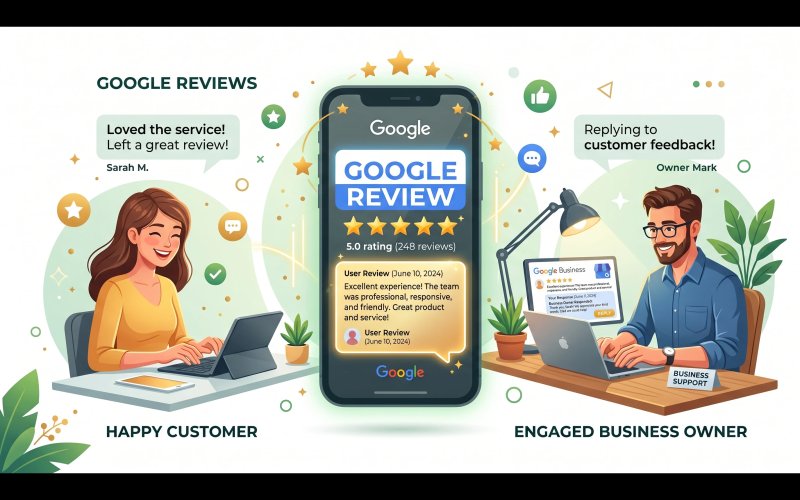
Reviews Are Infrastructure, Not a Vanity Metric
Google's local ranking algorithm has three primary components: relevance, distance, and prominence. Reviews are one of the most significant inputs into the prominence calculation. The algorithm explicitly weighs review quantity, average rating, and review recency when determining which businesses appear in the local pack. This means your review count is not just social proof for potential customers — it is a direct ranking signal that determines whether people can find your business on Google Maps at all.
The data is consistent: businesses in the top 3 positions of Google Maps have, on average, more than 4 times as many reviews as businesses ranked 7 to 10. This is not a coincidence. It is a pattern that holds across virtually every industry and every city we have analyzed. If you want to rank number 1, you need more reviews than your competitors, more recent reviews, and a higher response rate on those reviews.
This guide covers every aspect of Google review management: how to generate reviews at scale without violating Google's guidelines, how to respond to positive reviews in ways that build engagement, how to handle negative reviews without making them worse, how to request removal of fake or policy-violating reviews, and how to build a review system that compounds in value over time.
Part 1: Building a Review Generation System That Runs Without Constant Effort
Why Verbal Review Requests Almost Never Work at Scale
Most business owners rely on verbal requests. At the end of a service call, during checkout, or after a great appointment they say something like: "If you were happy with us, we would really appreciate a Google review!" It feels natural in the moment. It almost never produces reviews at meaningful scale.
The problem is not customer willingness — most satisfied customers are genuinely happy to leave a review for a business they like. The problem is friction. A customer who received a verbal request has to: remember to do it later, search for your business on Google, navigate to the reviews section, figure out how to compose a review, and actually write and submit it. Most people abandon this process somewhere between steps 1 and 3. The solution is to eliminate every single one of those steps by sending a direct link at exactly the right moment.
The Two-Touch SMS Method — The Most Effective Review Generation Approach Available
This is the most consistently effective review generation method we have tested across hundreds of businesses in dozens of industries. It works for any service business that has the customer's mobile number — which is most service businesses.
Message 1 — The Connection Text, sent within 30 to 60 minutes of service completion:
"Hi [First Name], this is [Your Name] from [Business Name]. Thank you so much for choosing us today — it was a genuine pleasure working with you. If there is anything at all about your experience you would like us to know, just reply to this text."
This message does two critical things. First, it opens a direct communication channel while the emotional experience is fresh and positive. Second, it gives any unhappy customer a private outlet to share their concern — which dramatically reduces the likelihood they will post a negative review publicly instead. If someone replies with a complaint, you handle it personally and do not send the second message. This alone filters out most negative reviews before they reach Google.
Message 2 — The Review Request, sent 48 to 72 hours later to customers who did not respond negatively:
"Hi [First Name], quick follow-up from [Business Name]. We hope everything with your [service] went perfectly. If we earned it, a Google review means the world to our small team and takes less than 60 seconds: [DIRECT REVIEW LINK]. Thank you so much — you are genuinely helping a local business grow."
The 48 to 72 hour delay is deliberate. It gives the customer time to experience the full result of your service while the positive emotion is still present. The direct link eliminates all search friction. "If we earned it" removes the feeling of pressure. The personal signature maintains the human connection established in the first message.
How to Get Your Direct Google Review Link
Step 1: Search your business name on Google. Step 2: Find your Knowledge Panel on the right side of results. Step 3: Click "Reviews" or the star rating. Step 4: Click "Get more reviews" or "Write a review." Step 5: Copy the URL in your browser address bar. This link takes customers directly to the review compose screen — no searching required, no intermediate steps. This single change typically doubles review submission rates compared to sending customers to your website and asking them to find the review link themselves.
The Email Sequence for Professional Services
For businesses where SMS feels too casual — law firms, medical practices, financial advisors, accountants — an email sequence works equally well with a more formal tone.
Email 1, sent the same day as the service, subject "Thank you from [Business Name]": A brief, warm, personal thank-you. Do not ask for a review in this email. Simply express genuine appreciation and invite them to reach out with any questions. Sign it personally from the owner or the specific person they worked with.
Email 2, sent 3 to 4 days later, subject "Quick question about your experience": "Hi [Name], I wanted to check in and make sure everything with your [service] has been exactly what you expected. If there is anything you would like to discuss, please reply directly. And if we delivered on our promises, a Google review helps our team enormously: [link]. It takes less than a minute and makes a real difference for a local practice. Thank you."
Automating the System for Consistent Volume
At any meaningful volume, manually sending individual review requests is unsustainable. The solution is automation through your CRM, job management software, or a dedicated reputation management platform. The ideal automated flow: job marked complete triggers an immediate thank-you message, which triggers a review request 48 to 72 hours later if no negative reply was detected. The entire process runs in the background continuously.
Most modern field service software — ServiceTitan, Jobber, Housecall Pro — has built-in or integrable review request automation. Medical and dental practice management systems typically have similar features. CRM platforms like HubSpot, GoHighLevel, and Keap can automate this workflow with minimal setup. If your current software does not support this, dedicated tools like Podium, Birdeye, and NiceJob specialize in exactly this process.
Part 2: Responding to Reviews — The Art and Science of Public Communication

Why Your Responses Are Read More Than the Reviews Themselves
Research from Harvard Business Review found that businesses that respond to reviews see measurable improvements in customer perception over time. More importantly for conversion purposes: when a prospective customer reads your reviews, they inevitably also read some of your responses. They are not just evaluating what happened to previous customers — they are evaluating how your business handles situations. Your response to a 1-star review tells a prospective customer more about your character and professionalism than the review itself does.
Responding to 5-Star Reviews — Be Specific and Personal
"Thank you for the 5-star review!" is a missed opportunity. A specific, personal response demonstrates that a real human read the review, signals to all future readers that your business pays genuine attention, and gives you a natural opportunity to mention additional services. Use their first name. Reference what they mentioned specifically. Express genuine appreciation. Invite them back or mention something related. Sign with your name.
Strong 5-star response example: "Thank you so much, Marcus — we really loved working with you on your kitchen renovation. The cabinet installation was one of our favorite recent projects and it sounds like you are thrilled with how it turned out. If you ever need anything with your bathroom, garage, or outdoor space, we are always just a phone call away. Thanks again for trusting us with your home."
The Authority Response Method for Negative Reviews
There is a right way and a very wrong way to respond to negative reviews. The wrong way — which costs businesses real customers every day — is to respond defensively, to argue with the reviewer, to explain why they are wrong, or to dismiss their complaint as exaggerated. The right way has one primary goal: reassure the prospective customer who is reading the exchange, not convince the unhappy reviewer of anything.
Rule 1 — Wait before responding. Never respond to a negative review in the moment if you are emotionally activated. Close the tab. Come back in an hour or the next morning. Every word in your response is permanent and public.
Rule 2 — Acknowledge without admitting wrongdoing. "We are sorry to hear your experience did not meet your expectations" is legally and reputationally very different from "We are sorry we did a bad job." The first acknowledges their feeling. The second confirms the accuracy of their complaint.
Rule 3 — Move the conversation offline immediately. Your public response should be 3 to 4 sentences maximum. Acknowledge the experience, express that you want to resolve it, and provide a direct contact with a specific name.
Rule 4 — Never negotiate publicly. Never offer a refund, discount, or free service in a public response. This behavior trains bad actors to post negative reviews expecting compensation.
The template: "Hi [Name], thank you for sharing your experience. What you have described is not the standard we hold ourselves to, and we are sorry your visit did not reflect that. We would genuinely like to understand what happened and make it right — please contact [name] directly at [email or phone] and we will personally take care of this. — [Your Name], [Business Name]"
Part 3: Fake Reviews — Detection, Reporting, and Resolution
How to Identify Fake Reviews
Fake reviews from competitors, disgruntled ex-employees, or paid review farms are more common than most business owners realize, especially in competitive local markets. Signs of a likely fake review: the reviewer has no profile photo and no other reviews on their account, or has only reviewed one or two other businesses. The review contains no specific details about a real service experience. The review mentions your competitor by name. Multiple suspicious reviews were posted on the same day or within a short period. The reviewer has left reviews for businesses across multiple unrelated cities.
The Removal Request Process
Google will remove reviews that violate their content policies. Reviewable policy violations include: spam and fake engagement, off-topic content, restricted content (such as content that makes illegal claims), illegal content, terrorist content, sexually explicit content, offensive or derogatory content, and dangerous or harmful content. A genuinely negative review from a real customer, however unfair it feels, does not qualify for removal unless it also violates one of these specific policies.
To flag a review: Go to Google Maps, find your business, click on the specific review, click the three dots next to it, select "Report review," and choose the most specific violation category. Google typically responds within 3 to 5 business days. If your initial report is denied, you can escalate through the Google Business Profile Help Community or through the GBP support chat.
Part 4: Building a Review Moat — The Long-Term Competitive Strategy
The Compound Effect of Consistent Monthly Generation
A business that generates 15 reviews per month will accumulate 180 new reviews in one year. A competitor generating 2 per month will accumulate 24. After just 3 years, the consistent business has a 7 to 1 review volume advantage that is nearly impossible for a late-starting competitor to overcome quickly. Reviews compound like interest. The businesses with 400 and 500 reviews in competitive local markets did not get there overnight — they built a system and ran it consistently for years while their competitors relied on occasional verbal requests.
This is why review generation is one of the most durable competitive investments in local SEO. The advantage you build compounds continuously, and a competitor cannot close a 3-year consistency gap in 3 months even with an aggressive campaign.
Ready to build a review generation system for your business? SBGeeks manages reviews as part of every GBP management plan — including an automated two-touch review request system, professional response management for every review, and monthly reporting on review velocity, rating trends, and competitive benchmarking.
Part 5: Platform Diversification — Building Reputation Beyond Google
Why Google-Only Review Strategy Is Increasingly Risky
Google reviews are the highest priority for local search ranking, and that will remain true for the foreseeable future. But relying exclusively on Google for your review presence creates a single point of failure. Google periodically performs review purges when their algorithm suspects inauthentic activity — and genuine reviews sometimes get swept up in these purges. Businesses that had 150 Google reviews and then saw their count drop to 80 after a purge event know exactly how destabilizing this can be.
A diversified review presence across multiple platforms creates resilience. When your Google count fluctuates, your Yelp presence, Facebook rating, and industry-specific platform reviews collectively maintain your reputation signals. More importantly, different customer segments check different platforms. Younger demographics often check Yelp. B2B buyers check LinkedIn and industry directories. Healthcare patients check Healthgrades and ZocDoc. Meeting your potential customers on their preferred platform requires presence beyond Google alone.
Platform Priority by Business Type
For restaurants, bars, and food establishments: Yelp is essentially as important as Google for restaurant searches specifically. TripAdvisor matters significantly for tourist-adjacent locations. OpenTable matters for reservation-driven traffic. Focus on Google first, then Yelp, then TripAdvisor depending on your location's tourist exposure.
For home service businesses — plumbers, HVAC, electricians, cleaners: Google is primary. After Google, Angi (formerly Angie's List) and HomeAdvisor carry significant weight for customers specifically seeking vetted contractors. Houzz matters for design-adjacent home services. Nextdoor Business matters for neighborhood-level trust building in your immediate service area.
For healthcare and medical businesses: Healthgrades, Vitals, and ZocDoc are legitimate referral sources for patients who specifically research medical providers before booking. These industry-specific platforms also have strong domain authority and often rank on page 1 of Google for your name plus specialty, meaning they represent both a direct traffic source and a reputation management consideration.
For legal businesses: Avvo, Martindale-Hubbell, and Super Lawyers are the industry-standard credentialing platforms that serve dual purposes — they generate direct referrals from legal-specific searches, and they contribute authoritative citations and brand signals to your overall online reputation.
How to Request Reviews on Secondary Platforms Without Overwhelming Customers
Asking every customer to leave reviews on 4 or 5 different platforms simultaneously is counterproductive — it creates decision paralysis and results in no review being left at all. The most effective approach for secondary platforms is to rotate your ask on a monthly basis rather than asking for multiple platforms simultaneously.
Month 1: All new reviews directed to Google. Month 2: Primary ask is still Google, but for customers who have already reviewed you on Google (you can check), direct them to Yelp with a different link. Month 3: Primary is Google, secondary ask for new segment goes to Facebook or your industry-specific platform. This rotation approach builds all platforms over time without overwhelming any individual customer with multiple requests.
Part 6: Monitoring and Reporting — How to Know If Your Review Strategy Is Working
Key Metrics to Track Monthly
Review management, like all marketing activities, needs to be measured to be improved. Track these five metrics every month to understand whether your strategy is working and where to adjust.
Review velocity: How many new reviews did you receive this month compared to last month and the same month last year? The trend line matters more than any single month's total. If your monthly velocity is declining, your review request system needs attention regardless of your total count.
Average rating trend: Is your average rating going up, staying flat, or declining? A declining average rating despite ongoing review generation is a signal about service quality, not about your review strategy. Do not try to mask declining quality with review volume — address the root cause.
Response rate and response time: What percentage of reviews are you responding to, and how quickly? Set a goal of 100% response within 24 hours for negative reviews and 48 hours for positive reviews. Track this metric explicitly — it is easy for response rate to slip when business is busy.
Competitive benchmark: How does your review count, rating, and velocity compare to the top 3 businesses ranking above you in Google Maps? This relative comparison is more actionable than your absolute numbers in isolation. If you have 80 reviews and the number 1 ranking business has 150, you know exactly how much runway you need to build. If they are generating 20 reviews per month and you are generating 8, you know you need to at minimum match their velocity before you can close the gap.
Review source mix: What percentage of new reviews are you receiving on Google versus Yelp versus other platforms? This tells you whether your rotation strategy is working and where your customers are most willing to engage.
Tools for Monitoring Review Activity
Several tools make review monitoring significantly more efficient than manually checking each platform daily. Google Business Profile's built-in notifications will alert you via email when a new review is posted — enable these in your GBP settings to ensure prompt response. For multi-platform monitoring, tools like BrightLocal, Birdeye, Podium, and ReviewTrackers aggregate reviews from multiple platforms into a single dashboard, allow you to respond from one interface, and provide analytics on your velocity and rating trends over time. For businesses with high review volume across multiple locations, these consolidated tools quickly justify their cost in time savings and consistency of response.
When to Escalate — Signs Your Review Strategy Needs Immediate Attention
Most review management issues are gradual and manageable. But certain patterns require immediate action. If you receive 3 or more 1-star reviews within a 30-day period from accounts with no review history or suspicious patterns, you may be under a coordinated fake review attack — escalate immediately through Google's report function and document every suspicious account. If your total review count drops significantly in a short period (more than 10% in 30 days), Google may have performed a purge affecting your profile — check their review policy updates and contact GBP support to understand whether the removed reviews violated guidelines or were incorrectly removed. If your average rating drops below 4.0, pause active review generation briefly and conduct an internal service audit to understand the root cause before continuing to request reviews from potentially dissatisfied customers.
Your review management strategy is not a set-and-forget system. It requires attention, adaptation, and monthly review of the metrics described above. The businesses with the most dominant review profiles in competitive local markets treat review management as a permanent, staffed business function — not a project that was completed at some point in the past. SBGeeks handles every aspect of this for clients on our management plans, including monitoring, response drafting, and monthly velocity reporting.