
Most Local Businesses Do Not Know Why They Are Not Ranking -- And That Is the Whole Problem
Here is a question worth sitting with for a moment: do you know, with any precision, why your business ranks where it does in Google Maps search results? Do you know which specific aspects of your Google Business Profile are strong, which are weak, and which are so deficient that they are actively suppressing your visibility for high-intent searches? Do you know how your profile compares, dimension by dimension, to the businesses that are currently ranking above you for the searches that matter most to your revenue?
For the vast majority of local business owners, the honest answer to all of those questions is no. They know they are not ranking as well as they would like. They may have a general sense that they should be doing more with reviews, or posting more regularly, or getting more photos up. But they do not have a clear, objective picture of exactly where their profile is strong and exactly where it is failing -- which means they are making optimisation decisions based on guesswork and general advice rather than on a specific diagnosis of their own situation.
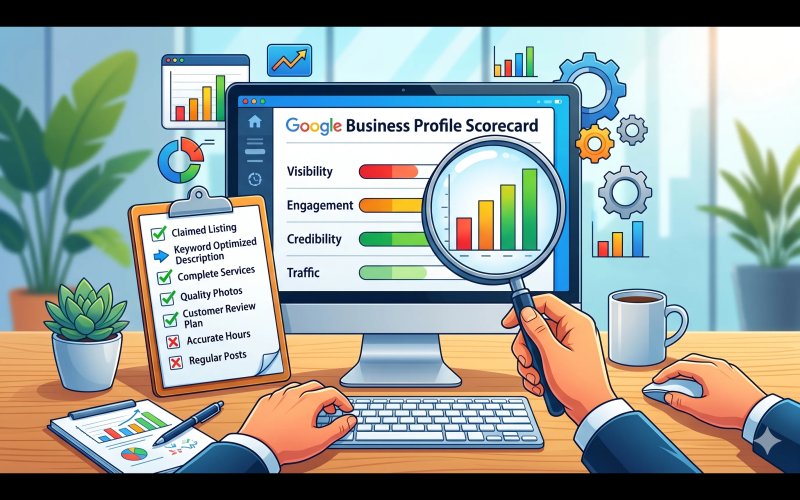
This is the problem that a Google Business Profile audit solves. A GBP audit is a systematic, comprehensive evaluation of your profile across every dimension that Google uses to determine local search rankings. It produces a clear score, a category-by-category breakdown, and a prioritised list of specific actions ranked by their likely impact on your local search visibility. It transforms your local SEO from guesswork into strategy.
The best part: you do not need to hire an agency or wait for a consultant's schedule to clear. Our free GBP audit tool delivers a complete audit of your profile in under two minutes -- and it is completely free. But before you run it, read through this guide to understand what a GBP audit covers, how to interpret your results, and exactly what to do with the findings once you have them.
What Is a GBP Audit and What Does It Actually Measure?
A Google Business Profile audit is a structured evaluation of your GBP listing across all the dimensions that influence your local search visibility. A thorough audit does not just check whether you have filled in the basic fields -- it evaluates the depth and quality of each element, compares your profile against the competitive baseline needed to rank in your specific market, and identifies not just what is missing but what is underperforming relative to its potential.
The best GBP audits evaluate seven core dimensions:
Dimension 1: Profile Completeness
Completeness is the starting point of any GBP audit, and it goes much deeper than most business owners expect. Yes, it checks whether you have a business name, address, phone number, and website -- those are just the beginning. A thorough completeness assessment also evaluates: has your business description been written and does it use the full 750 characters? Has every service been added to the Services section with a complete description? Have all applicable attributes been checked? Is the Q&A section populated with proactively added questions and answers? Are the products section and booking integration configured if relevant?
Research consistently shows that most local businesses have completed between 30% and 50% of their available profile sections. The other 50-70% -- the sections that most businesses leave empty -- are the sections that separate top Map Pack performers from businesses buried on page two and three. Completeness is also cumulative: each additional section you complete adds to a profile that Google interprets as more legitimate, more active, and more worthy of prominent local visibility.
Dimension 2: Category Optimisation
Your primary category is one of the most powerful ranking signals available to you, and getting it wrong costs you more visibility than almost any other mistake. A thorough category audit evaluates: is your primary category the most specific accurate description of your core service? Does it align with the categories used by the top-ranking businesses for your target searches? Are your secondary categories genuinely relevant to services you offer, or are they padding that dilutes your primary relevance? Do you have any categories that contradict your primary positioning?
Category errors are extraordinarily common. Many businesses chose their category quickly at setup and have never revisited it. Many chose the broadest available category because it seemed safe. Many are unaware that more specific categories exist that would serve them far better. A category audit identifies these misalignments and quantifies the likely ranking impact of correcting them.
Dimension 3: Review Profile Health
Review health is often the most impactful single dimension in a GBP audit for businesses that are underperforming in local search. This dimension evaluates multiple aspects of your review situation: total review count and how it compares to your market competitors, average star rating, recency distribution (are you getting new reviews consistently or did they all come in a burst and then stop?), your response rate and response quality, and the richness and keyword relevance of review content.
A comprehensive review audit will identify not just how many reviews you have but whether your review generation is systematic and ongoing or accidental and sporadic. It will identify whether your response patterns demonstrate engaged, professional profile management or disengagement. And it will identify the specific gaps between your current review profile and the review profile needed to compete effectively for your target searches in your specific market.
Dimension 4: Visual Content Assessment
The visual content audit evaluates both the quantity and the quality of your photo and video library. How many photos do you have in total? How recently was the last photo added? Are all the major photo categories covered -- exterior, interior, team, products or services? Are there any videos? Are the photos high quality, authentic, and specific to your actual services, or are they generic stock images that provide no semantic value to Google's Vision AI?
In 2026, photo assessment has become more technically nuanced because Google's Vision AI now extracts meaning from photo content. An audit that simply counts your photos and checks their categories is missing the more important question: are your photos the kind of specific, authentic, high-quality images that create genuine AI relevance signals, or are they the kind of generic visuals that exist on the profile but contribute little to your ranking position?
Dimension 5: Activity and Engagement Signals
Google's algorithm weights activity signals heavily -- recent posts, recent photo additions, prompt review responses, Q&A engagement. An activity audit evaluates how recently and consistently your profile has been maintained. When was your last post? When was your last new photo? What is your average review response time? Is your Q&A section being monitored and updated?
Activity signals matter because they tell Google that your business is currently operational, engaged with customers, and actively managed. An inactive profile, even one that was well-constructed two years ago, gradually loses ground to actively maintained competitors as its activity signals age and the gap in freshness widens. The activity audit identifies how large this gap has become and what a realistic activity schedule would look like to address it.
Dimension 6: NAP Consistency Check
NAP consistency -- your Name, Address, and Phone number being identical across every online listing -- is a foundational trust signal that a thorough GBP audit must include. At minimum, the audit should verify that your GBP information is consistent with your website (footer, contact page, and schema markup), your Facebook business page, Bing Places, and your top 3-5 industry-specific directories. Inconsistencies here actively suppress your local prominence score.
The most common NAP issues found in GBP audits: an old phone number still showing on directories after a number change, minor business name variations between platforms, address formatting differences, and duplicate GBP listings created at some point in the past that are now splitting your authority. Each of these is fixable, but you have to know they exist before you can fix them.
Dimension 7: Technical Signals
The technical dimension of a GBP audit looks beyond the profile itself to the signals on your website that affect your local search authority. The most important technical signals are: does your website have LocalBusiness schema markup? Is the schema data consistent with your GBP information? How does your website perform on mobile -- loading speed, responsiveness, above-the-fold clarity? Is your website's core content consistent with and supportive of your GBP category and service claims?
Technical signals on your website directly affect your GBP ranking because Google evaluates your website as part of assessing your overall local authority. A slow, poorly structured website that is inconsistent with your GBP claims creates a trust disconnect. A fast, mobile-optimised website with comprehensive schema markup that is entirely consistent with your GBP profile creates a reinforcing set of signals that compounds your local authority.
How to Interpret Your GBP Audit Score
Different audit tools use different scoring methodologies, but most comprehensive GBP audits produce an overall score expressed as either a percentage or a letter grade. Here is a general framework for interpreting where your score places you relative to competitive market standards:
85-100 / Grade A: Your profile is comprehensively optimised. You are likely ranking competitively for your core target searches, and your profile is generating meaningful lead volume from local search. The work at this level is maintenance: continuing to add new photos weekly, maintaining your posts schedule, sustaining your review generation process, and monitoring for new profile features to adopt. You are not done -- local search is not static -- but you are in a strong position.
70-84 / Grade B: Your profile has a solid foundation with identifiable specific gaps. You are probably ranking reasonably well for some of your target searches but underperforming for others. The audit will have identified 3-5 specific areas where focused improvement will produce meaningful ranking gains. At this level, targeted optimisation in the weakest areas typically produces visible results within 30-60 days.
50-69 / Grade C: Multiple important profile sections are incomplete or significantly underperforming. You are likely invisible or buried for most of your target local searches, and the gap between your current position and competitive Map Pack rankings is meaningful but absolutely closeable with systematic work. A structured 90-day optimisation plan addressing the audit findings in priority order will produce substantial improvement.
Below 50 / Grade D: Your profile has critical gaps and is significantly underperforming. There are likely active errors -- wrong categories, NAP inconsistencies, missing contact information, or duplicate listings -- that are suppressing your rankings beyond just the incompleteness issues. A structured remediation plan starting with the critical errors and then working through completeness and activity elements is the right approach. The potential for improvement at this level is enormous, but it requires systematic effort.
What to Do With Your Audit Results
Phase 1: Fix Critical Errors (Days 1-14)
Critical errors are the specific issues that are actively suppressing your rankings rather than simply not optimising them. Wrong primary category, NAP inconsistencies on major platforms, duplicate GBP listings, missing or incorrect contact information, unverified listing status. These must be fixed before anything else, because they undermine the value of every other optimisation activity you undertake. A perfect photo library and weekly posts cannot compensate for being in the wrong category.
Phase 2: Complete Profile Sections (Days 15-45)
With critical errors resolved, work systematically through all incomplete profile sections. Start with the Services section -- it is typically the highest-impact incompleteness for most businesses. Then the business description (rewrite it to full 750 characters with the framework described in our GBP optimisation guide). Then attributes (check every applicable option). Then Q&A (add 10-15 proactively created questions with comprehensive answers). Then visual content (shoot new photos and establish a weekly upload schedule).
Phase 3: Build Review and Activity Systems (Days 30-60)
Parallel to profile completion, establish the ongoing systems that produce compounding results: a review generation process that is built into your standard post-service workflow, a weekly posts schedule that is planned a month in advance and assigned to a specific team member, a review response protocol that ensures every review receives a personalised response within 24 hours. These systems do not produce instant results, but they produce results that compound dramatically over 6-12 months.
Phase 4: Off-Profile Authority Building (Ongoing)
Once your profile is strong and your activity systems are running, turn attention to off-profile signals: citation consistency across your wider directory footprint, local link building through genuine community involvement and partnerships, schema markup on your website, and local content creation that builds geographic authority in your target service areas. These signals compound slowly but create the most durable and defensible local search rankings.
How Often Should You Audit Your GBP?
A baseline audit should be done immediately if you have never systematically evaluated your profile -- this establishes your starting point and identifies your critical gaps. After your initial remediation work is complete, a full audit every quarter is the right cadence for maintaining peak performance. Google adds new profile features and attributes regularly, and a quarterly audit catches new opportunities as they emerge before your competitors do.
Between full audits, monthly check-ins on your activity signals -- reviewing your recent post consistency, your photo upload frequency, your review response rate, and your new review count -- keep your profile performing at its best between deeper evaluations. Set a recurring monthly calendar reminder for this check-in so it does not get deprioritised when business gets busy.
The Real Cost of Not Auditing
Every month you operate your Google Business Profile without a clear understanding of its strengths and weaknesses is a month where preventable issues are costing you real customers and real revenue. A business with a Grade D profile ranking on page three is not just missing out on a few extra enquiries -- it is watching those enquiries go to a better-optimised competitor, every single day, without ever knowing it.
Consider the math: if a Grade D profile generates 14 qualified enquiries per month from local Maps search, and a fully optimised Grade A profile in the same market generates 80-90, the cost of the unoptimised profile is 65-75 missed enquiries every month. At a typical local business conversion rate of 20-30% from enquiry to customer, that is 13-22 customers per month that are going to a competitor because their GBP is better than yours. At even a modest average customer value, that is a significant monthly revenue gap that an audit and a systematic optimisation effort could begin closing within weeks.
A GBP audit is not a nice-to-have diagnostic for businesses with time to spare. It is the essential starting point for any local business that is serious about its digital presence and wants to compete effectively for the high-intent local customers who are searching for exactly what it offers right now.
Ready to find out exactly where your Google Business Profile stands? Our free GBP audit tool gives you a comprehensive, personalised score across all seven audit dimensions, identifies your critical issues, and provides a prioritised action plan -- completely free, in under two minutes. And to continue building your local SEO knowledge, explore the full library of expert guides on our SBGeeks blog.
Frequently Asked Questions
Is a GBP audit the same as a full local SEO audit?
A GBP audit focuses specifically on your Google Business Profile and the immediate signals that affect your local Map Pack rankings. A full local SEO audit is broader and includes your website's technical health, content strategy, backlink profile, citation consistency across the full web, and competitive analysis. A GBP audit is the right starting point for most local businesses because the GBP has the most direct and fastest impact on local Map Pack visibility.
How much does a professional GBP audit cost?
Professional GBP audits from local SEO agencies typically range from £200-£800 depending on the depth of analysis and the competitive benchmarking included. Our free GBP audit tool provides a comprehensive automated audit covering all the major dimensions at no cost, making it an excellent starting point for any business.
What is the most common critical issue found in GBP audits?
The most consistently found critical issue is an incomplete or suboptimal Services section -- most businesses either have no services listed or have only listed service names without descriptions. The second most common is a wrong or overly generic primary category. The third is a zero or near-zero review response rate despite having reviews available to respond to. All three are immediately fixable once identified.
Can I do a GBP audit myself without a tool?
You can manually assess many elements of your profile -- checking completeness, reviewing your category choice, counting your photos, reviewing your response rate. However, without a tool, you miss the comparative dimension of the audit -- how your profile compares to the competitive baseline needed to rank in your specific market. A manual audit tells you what you have. A tool-assisted audit tells you what you have relative to what you need to compete, which is the more actionable insight.