What Makes Service Area Business SEO Fundamentally Different
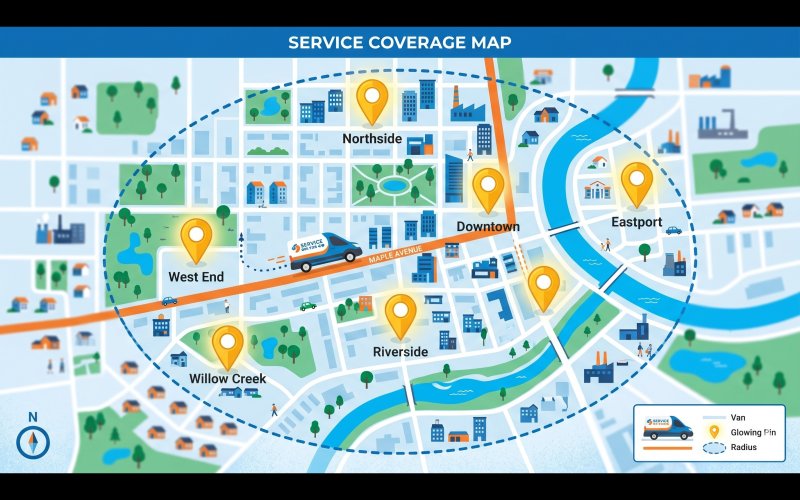
A service area business is any business that travels to the customer's location to deliver its services. Plumbers, electricians, HVAC technicians, house cleaners, landscapers, mobile pet groomers, mobile mechanics, home inspectors, pest control companies, and thousands of other business types fall into this category. Unlike a brick-and-mortar business where location is fixed and visible to anyone searching nearby, a service area business serves a geographic territory that might span dozens of zip codes, multiple cities, or entire counties.
This creates a set of local SEO challenges that do not apply to traditional location-based businesses. Google's proximity ranking factor — which gives preference to businesses physically closest to the searcher — functions differently when a business does not have a public-facing address. The service area you define in your GBP tells Google where you operate, but it is treated as a weaker proximity signal than a verified physical location. This means service area businesses must work harder on every other ranking factor to compensate for this structural proximity disadvantage.
This complete guide covers the entire playbook for SAB local SEO: how to set up your GBP correctly from day one, how to define and expand your service area strategically as your business grows, how to rank in cities where you have no physical presence, how to build the local signals that boost your visibility across your entire service footprint, and how to compete against established brick-and-mortar competitors on their home turf.
Part 1: Getting the GBP Foundation Right for Service Area Businesses
The Address Question: What to Enter and What to Hide
Google allows service area businesses to hide their physical address from their public GBP listing while still using that address for internal verification and ranking purposes. This is the correct approach if your address is a home office or a location where you do not receive or serve customers in person. Displaying a home address publicly creates safety concerns and also confuses searchers who might try to visit you in person expecting a storefront experience.
The setup process: Go to your GBP, click "Edit profile," navigate to the business location section, enter your actual physical address in the internal field (this cannot be a PO Box or virtual mailbox — it must be a genuine physical location where you are based), then check "I deliver goods and services to my customers at their location" and check "Hide my address." This configuration tells Google you are a service area business, removes your address from public view, and keeps your location data available for the proximity algorithm.
The critical rule: you must enter a real, legitimate physical address. Google verifies SAB addresses through the same postcard verification process as regular listings. If you enter a fake or non-deliverable address, your listing will eventually be suspended. A home office address is perfectly acceptable under Google's guidelines — you are simply hiding it from public display while Google uses it for internal ranking calculations.
Service Area Configuration — Be Accurate, Not Ambitious
Google allows you to define your service area using specific cities, zip codes, counties, or a geographic radius from your hidden address. The most common and most damaging mistake service area businesses make is defining an enormous, aspirational service area hoping to appear in as many searches as possible. This strategy consistently backfires.
Google does not reward claims of serving a large area — it rewards genuine relevance signals in specific locations. A plumbing company that claims to serve 50 cities but only has customer reviews, citations, and website signals from 5 of those cities will rank well in those 5 cities and poorly in the other 45. Defining an honest, accurate service area — the cities where you actually do the majority of your work — produces better results than an inflated area that you cannot support with genuine local signals.
Start with your core service territory. Add cities as you genuinely expand your operations there and accumulate real local signals — reviews from customers in that city, a citation from that city's local directory, a landing page for that city on your website. Your service area in your GBP should reflect where you genuinely operate, not where you hope to operate someday.
Category Selection for SABs — Even More Critical Than for Storefront Businesses
Because proximity is a weaker ranking signal for service area businesses, your categories carry proportionally more weight in the relevance calculation. A storefront business with a mediocre category selection can still rank for proximity-dominant searches. A service area business with poor categories has no proximity advantage to fall back on.
Choose the most specific available primary category for your core service. Add all 9 secondary category slots with every legitimate service you offer. A residential cleaning company should use "House Cleaning Service" as its primary (not the generic "Cleaning Service"), and add "Commercial Cleaning Service," "Window Cleaning Service," "Carpet Cleaning Service," "Move Out Cleaning Service," and "Office Cleaning Service" as secondary categories — covering every specific service they offer and every category those specific services rank under.
Part 2: Ranking in Multiple Cities Without a Physical Location
Why Ranking in Non-Home Cities Is Hard and Why You Must Do It Anyway
Ranking in cities where you have no physical presence is legitimately challenging. A plumbing company headquartered in Austin has a natural ranking advantage for "plumber Austin" searches because proximity favors them. For "plumber Round Rock" — even if Round Rock is 20 miles away and well within their service area — the proximity advantage is reduced and may favor a company headquartered in Round Rock, even if that company is less experienced or less well-reviewed.
Overcoming this proximity disadvantage requires building genuine local relevance signals in each target city. The three most impactful signals you can build are: city-specific landing pages on your website, reviews that mention the specific city, and local citations from that city's directories and community organizations.
City-Specific Landing Pages — The Highest-Impact Investment for Multi-City SABs
Creating individual landing pages on your website for each city you serve is the most effective way to build local relevance for those cities and support your GBP ranking there. Each city page tells Google: we genuinely operate in this specific location, we serve customers there, and here is the content that proves it.
The URL structure should be: yourdomain.com/service/city-name or yourdomain.com/city-name-service. The content on each page must be unique — not simply a copy of another city's page with the name swapped. Google detects thin, duplicated city pages and treats them as low-quality content that does not deserve ranking. Write at least 400 to 600 words of genuine, unique content per city. Include: what services you offer in that city specifically, how long you have served that community, any local references that are authentic (neighborhoods, landmarks, local context), and a clear call to action.
A plumbing company serving 10 cities needs 10 city pages. This is significant work upfront. It is also one of the most durable local SEO investments you can make, because well-executed city pages generate organic traffic and GBP ranking support for years with minimal ongoing maintenance.
Building Local Reviews and Citations for Each Target City
For each city you want to rank in, actively work to generate reviews from customers in that city specifically. When you complete a job in Round Rock, that is when you send the review request — and a review that naturally mentions "Round Rock" in its text is a stronger geographic relevance signal than a generic positive review with no location context.
Similarly, find and claim local directory listings specific to each target city. City chambers of commerce, neighborhood business associations, local news site business directories, and community organization websites all provide geographically specific citation signals. A listing on the Round Rock Chamber of Commerce website is a stronger local signal for Round Rock searches than any number of national directory listings.
Part 3: Competing Against Established Brick-and-Mortar Competitors
Understanding the Relevance vs. Proximity Battle
When an SAB and a brick-and-mortar business with the same primary address compete for the same search query, the brick-and-mortar business starts with a structural proximity advantage. To overcome this, the SAB needs to win decisively on relevance and prominence factors. This means: more reviews with stronger recency, better profile completion, more consistent posting activity, stronger website signals, and more topically relevant citations. Every factor within your control needs to outperform the competitor you are trying to beat.
This gap is absolutely closeable — we have documented it closing for clients in competitive markets including legal, medical, and home services. But it requires a systematic approach and sustained execution over 60 to 90 days minimum before ranking improvements become consistently visible.
Reviews as a Proximity Equalizer
For service area businesses specifically, review volume has a disproportionate impact on rankings relative to its impact for storefront businesses. A well-reviewed SAB can rank above a higher-proximity storefront competitor by winning convincingly on prominence signals. An SAB with 200 recent reviews and a 4.8 star rating will consistently outrank a brick-and-mortar competitor with 40 reviews at 4.7 stars — even when the brick-and-mortar business is physically closer to the searcher.
This makes review generation the single highest-ROI activity for most service area businesses. Every new review you generate not only improves your prominence score directly but also contributes to closing the proximity gap through accumulated prominence advantage.
Part 4: Technical Local SEO for SAB Websites
LocalBusiness Schema Markup for Service Area Businesses
Your website should include LocalBusiness schema markup — structured data in JSON-LD format embedded in your site's code — that explicitly identifies your business type and service area. For SABs, the schema should include the "areaServed" property listing your service cities or regions. This helps Google understand your geographic coverage even without a publicly visible address, and it provides structured, machine-readable confirmation of your service territory that reinforces the service area you have defined in your GBP.
Mobile Optimization Is Non-Negotiable for SABs
Service area business searches — "plumber near me," "emergency HVAC repair," "cleaning service this week" — are overwhelmingly performed on mobile devices, often by people with immediate or urgent needs. If your website loads slowly on mobile or is difficult to navigate on a small screen, you are losing customers at the final conversion step of a funnel you have invested significant effort building. Use Google's free PageSpeed Insights tool to check your mobile score and fix any issues flagged as opportunities. A mobile score improvement from 40 to 80 often produces measurable improvements in both organic and GBP rankings within 30 to 60 days.
Want us to implement this playbook for your service area business? Request a free audit and we will analyze your current GBP configuration, service area setup, website local signals, and citation profile — then deliver a prioritized action plan specific to your market, your category, and your current competitive position.
Part 5: Tracking and Measuring SAB Local SEO Performance
What to Measure and How Often
Service area businesses face a specific measurement challenge: because you do not have a physical storefront, foot traffic data is not relevant, and your ranking position varies based on where the searcher is located within your service area. A business based in Austin will rank differently for searches from different parts of the city, let alone different cities within their service area. This geographic variability requires tracking tools that can measure ranking across locations, not just a single position.
The most important metrics for SAB local SEO: your GBP ranking at multiple points within your service area (geo-grid tracking), call volume from your GBP listing per month, click-through rate from search impressions to profile views, and direction request volume. Google Business Profile Insights provides much of this data for free — review it monthly and track trends over time rather than focusing on any single month's snapshot.
Geo-Grid Tracking for SABs
Geo-grid tracking tools — available through BrightLocal, Local Falcon, and similar platforms — show you your GBP ranking position at a grid of geographic points across your service area. Instead of knowing you rank "position 4" as a single number, you can see that you rank position 2 within 5 miles of your home base, position 6 from 10 miles away, and position 11 from the far edges of your service area. This granular view is essential for SABs because it reveals exactly which geographic areas need more attention.
When you identify a specific city or neighborhood where your ranking is weak relative to other areas, you know to focus your link building, citation building, and review request targeting on customers in that specific location to build the local signals that will improve your ranking there specifically.
Attribution: Understanding Where Your Calls Come From
For service area businesses, understanding which of your marketing channels generates which calls is essential for rational budget allocation. Google Analytics, your GBP Insights call tracking, and a dedicated call tracking number on your GBP can all help attribute inbound calls to their source. When a customer calls the number displayed directly on your GBP listing, that call is trackable to your GBP specifically. Calls to your website's main number may come from GBP-driven website visits, organic search, or other sources.
Implement a dedicated tracking number for your GBP listing that forwards to your main line. This creates a clean data signal: every call to that number came specifically from your Google Business Profile, allowing you to measure GBP call volume accurately month over month without any ambiguity.
Part 6: Scaling a Service Area Business Through Local SEO
Expanding Your Service Area Strategically
As your business grows and you begin serving new cities or expanding your geographic footprint, your local SEO strategy needs to scale accordingly. Do not simply expand your service area in your GBP settings and expect ranking to follow automatically — you need to build genuine local signals in each new area before claiming it as a service territory.
For each new city you want to add to your active service area, follow a sequenced approach: begin serving customers there first, request reviews specifically from those customers, build a city-specific landing page on your website, acquire at least one citation from a local directory in that city, and then update your GBP service area to include it officially. This sequencing means your ranking eligibility is supported by genuine local signals rather than just an unsubstantiated geographic claim.
When to Create a Second GBP Listing
As service area businesses grow, a common question is whether to create additional GBP listings for different service regions. Google's guidelines are clear: you may create separate listings for distinct locations where you have a genuine, staffed physical presence or where you have opened a genuine second business location. You may not create multiple listings for the same business at the same address to rank in different geographic areas — this is a guideline violation that can result in all listings being suspended.
If your business genuinely opens a second staffed office in a different city, create a second GBP listing for that location. If you simply want better ranking coverage in multiple cities from a single location, the tactics described in this guide — city landing pages, targeted review building, local citation acquisition — are the legitimate path to expanding your geographic ranking footprint.
The Competitive Compounding Effect Over Time
The advantages of consistent local SEO investment for service area businesses compound over time in a way that makes early investment disproportionately valuable. A business that starts review generation, citation building, and city page creation today will have a 2-year advantage over a competitor that starts the same program in 2 years. That 2-year head start manifests as a review count advantage that takes years to overcome, a citation profile that has been verified and propagated through the directory ecosystem repeatedly, and city pages that have accumulated ranking authority through consistent performance.
The businesses that dominate their local service area markets 3 to 5 years from now are the ones investing consistently in local SEO today — not waiting until the competitive pressure becomes unbearable. Request a free audit to see where your service area business stands today and what a realistic improvement roadmap looks like for your specific market.
The Economics of SAB Local SEO Investment
Calculating the Value of a Single Ranking Position Improvement
Service area businesses often underestimate the financial impact of Google Maps ranking improvements because the value is indirect — it comes through increased call volume rather than through a direct e-commerce transaction. But the math is straightforward and the numbers are compelling. If ranking from position 5 to position 2 for your primary keyword doubles your monthly call volume from Google Maps, and your average job value is $400, and you close 40% of calls into jobs, the revenue impact of that ranking improvement is: (additional monthly calls) x (40% close rate) x ($400 average job) = monthly revenue from ranking improvement.
For a cleaning company receiving 20 additional calls per month from a ranking improvement, at a 40% close rate and $250 average job: 20 x 0.40 x $250 = $2,000 per month in additional revenue. At an investment of $449 per month in professional GBP management, the break-even is well under 1 month and the ongoing ROI is approximately 4.5 times. For higher-value services, the math improves dramatically — an HVAC company with an average job value of $900 in the same scenario generates $7,200 per month in additional revenue from the same ranking improvement.
The Time Cost of DIY SAB Local SEO
Many service area business owners attempt to manage their local SEO themselves, which is entirely feasible for businesses in low-competition markets. But the time investment required to do it properly — and to keep up with algorithm changes, competitor activity, and platform updates — is substantial. A realistic estimate for DIY SAB local SEO that is genuinely competitive: 4 to 6 hours per month for ongoing maintenance (posts, photo uploads, review responses, citation monitoring), plus 20 to 30 hours upfront for initial setup and cleanup.
When you value your own time at your business's effective hourly rate, the math on DIY versus professional management often favors outsourcing the local SEO work and redirecting your time to service delivery. Every hour you spend managing GBP is an hour not spent completing a job, managing your team, or pursuing the higher-value activities only you can do. Our management plans are designed to deliver professional execution at a cost that is typically justified by ranking improvement within the first 60 to 90 days of service.